SHALLOW DEPTH OF FIELD 2HR WORKSHOP
Workshop — March 7, 2026: 10AM–12PM
Instructor — Sonny Green @ www.sonny.photos
Meeting Place — Clerks Coffee Company (Emeline Hotel)
181 Church St, Charleston, SC 29 401
(Meet at the four chairs in the center of the coffee shop.)
If late, text 843-843-6542 to find us.
Price: $50 per person
READ FIRST: How to Use This Guide
This is a group workshop — not a private lesson.
That means we move together, learn together, and stay roughly on the same page. The more aligned the group is in skill level, the smoother the workshop runs.
Please know how to operate your own camera (phone or DSLR/mirrorless) before class. You don’t need to know aperture numbers or lens math — that’s what you’re here to learn — but you should know how to change focus and exposure on your device.
This guide is a roadmap, not a contract.
We may not cover every section in two hours — there is intentionally more information than time, so you can use this as take-home material to keep growing.
Every concept comes with:
- what it means
- why it matters
- how it affects mood
- what we’ll practice in the field
The more open, curious, patient, and respectful we are as a group, the stronger the workshop becomes.
Thank you for joining.
OVERVIEW
Shallow depth of field is one of the most powerful visual tools in photography. With it, you can:
- isolate a subject
- create emotional focus
- simplify distracting backgrounds
- produce creamy, expressive bokeh
- guide the viewer’s attention with intention
This workshop teaches you not just how to blur a background, but why.
You’ll learn how aperture, focal length, subject distance, background distance, lens compression, and angle all shape emotion. We’ll break down the physics in simple language, then apply everything immediately in a live shooting environment.
Shallow depth of field is a craft you feel as much as understand. By the end of this workshop, you’ll know how to use blur as a storytelling choice — not a trick.
This workshop unfolds in three stages:
1. Understanding Depth of Field
You’ll learn the four forces that control blur. These aren’t random tricks — they’re the entire physics behind shallow depth of field. Once you understand them, you stop hoping for blur and start creating it on purpose.
A. Aperture (f-stops and how they work)
Aperture is the size of the opening in your lens.
Lower f-stop = bigger opening = more blur.
Higher f-stop = smaller opening = less blur.
Think of aperture like a doorway: the wider it opens, the harder it is for the whole room to stay in focus. Wide apertures (f/1.4–f/2.8) carve your subject out from the background. Small apertures (f/8–f/16) keep everything crisp.
Shallow depth of field is not luck — it’s distance and aperture working together. This is where beginners get it wrong. It’s not just f/1.8. It’s f/1.8 plus how close you are plus how far the background is.
B. Distance to Subject
Move closer, blur increases.
Move farther, blur decreases.
Every millimeter counts. Your feet are actually your most powerful blur tool. Stand too far away and even f/1.4 won’t give you the cinematic look you want. Move in close and suddenly the world melts behind your subject.
Get brave with distance. Most beginners stand too far back because they’re afraid of invading space. But blur lives in closeness.
C. Distance From Subject to Background
If your subject stands close to a wall → no blur.
If your subject stands far from a wall → blur for days.
You can shoot at f/5.6 and still get gorgeous separation as long as the background is far enough away. Background distance is the silent engine behind bokeh. You can have an expensive lens, but if your subject is one foot in front of a busy background, the blur dies.
Move your subject instead of changing your settings — it’s faster and smarter.
D. Focal Length and Compression
Wider lenses = more background in focus.
Longer lenses = more compression and more blur.
A 35mm lens keeps more in focus.
An 85mm lens melts backgrounds.
A 200mm lens turns backgrounds into pure color and shape.
Compression pulls the background closer visually while pushing it deeper out of focus physically. Long lenses create that dreamy portrait look where the world behind your subject becomes thick cream.
Use your focal length intentionally, not out of habit.
Practice Drill — “The Blur Ladder”
Pick one object — a coffee cup, plant, friend, whatever.
Photograph it four times:
- Shot 1: Wide lens (24–35mm), far away, background close.
- Shot 2: Move closer, same lens, background farther.
- Shot 3: Switch to 50–85mm. Same distance.
- Shot 4: Step even closer and let the background fall away completely.
Study how each variable changes blur.
Blur is not magic — it’s choices piled on choices.
Pro Tip — “Blur Isn’t About the Lens. It’s About the Space.”
When you walk into a location, don’t look at your subject first.
Look at the background distance.
If the background is too close, move them. If you can’t move them, move your angle so the background stretches out. The best blur comes from controlling the space, not the settings.
2. Creating Emotion With Blur
Shallow depth of field isn’t a technical flex — it’s emotional architecture. Blur is a storytelling tool. You’re not just softening backgrounds; you’re shaping how someone feels when they look at your image.
Blur tells the viewer where to look.
Blur tells the viewer how to feel.
Blur decides what matters and what doesn’t.
Here’s what we’ll use blur to do:
• Create Mood
Soft blur = gentle, romantic, dreamlike.
Hard blur = dramatic, punchy, emotional weight.
The less detail the background has, the more your viewer fills it in with emotion. Blur invites the viewer’s imagination to do half the work.
• Eliminate Distractions
Anything sharp competes.
Anything soft supports.
Blur removes the junk that kills a good photo: signs, people, cars, stray color, busy shapes. When the background melts, your subject breathes.
• Simplify Cluttered Scenes
Sometimes you don’t get a clean location. Blur turns chaos into atmosphere.
An alley becomes texture.
A busy street becomes tone.
A messy room becomes mood.
Blur reduces the world to shapes and light — perfect for storytelling.
• Make a Subject “Pop” Without Gimmicks
Forget filters. Forget over-editing.
Depth of field is the original “pop.”
A sharp subject against a soft background creates depth, separation, and clarity. It forces the eye into the story.
• Shape Bokeh Into Part of the Story
Bokeh isn’t random. It’s behavior.
The blurred circles come from three things:
- light source size (smaller = tighter bokeh, larger = softer bokeh)
- distance between subject and background
- lens design and aperture shape
Streetlights, string lights, sunlight through leaves, reflections off cars — these are “bokeh generators.” Learn to spot them. They turn the background into a painting.
• Circles of Confusion
This is the technical phrase for how big a blur circle must be before the eye reads it as “out of focus.”
Bigger circles = more obvious blur.
Smaller circles = subtle blur.
You don’t need the math — just know this:
blur is not a mistake; it is a design choice.
Practice Drill — “Find the Bokeh Makers”
Go outside at dusk or into a place with point lights.
Make 10 photos where the background lights are part of the story.
Try these:
- Lights behind your subject from far away.
- Lights close but out of focus.
- Streetlights hidden behind leaves.
- Reflections in windows or cars.
- Light passing through something translucent (fabric, plastic, glass).
Watch how blur changes the emotional temperature of the image.
Some shots feel cinematic.
Some feel quiet.
Some feel like memory.
Blur is emotion in disguise.
Pro Tip — “If You Want Strong Bokeh, Shoot Into the Light.”
Don’t hide from light sources.
Use them.
The best bokeh happens when:
- The background is bright
- The light is direct
- The shapes are small
- The distance is long
If you want blur that feels alive — bokeh you can practically taste — aim your shot toward the light, not away from it.
3. Fieldwork: Shooting With Intention
This is where shallow depth of field stops being theory and becomes muscle memory.
We’ll walk the historic streets near the Emeline — tight alleys, soft window light, textured walls, pockets of shade — and use the environment as a training ground.
Here’s what we’ll practice:
• Portraits With Clean Backgrounds
Before you lift the camera, look behind the subject.
If the background is chaotic, your depth of field has to work twice as hard.
We’ll practice shifting the subject left or right by inches to clean up the frame.
Simple background = stronger story.
• Portraits With Textured Bokeh
Brick, foliage, iron gates, distant traffic, reflections — Charleston is full of backgrounds that turn into beautiful blur.
You’ll learn to position your subject so the background becomes a painting, not a distraction.
• Shooting Wide Open vs. Stopped Down
Wide open (f/1.2–f/2.8):
Dreamlike. Emotional. Soft. Forgiving.
Stopped down (f/4–f/8):
Sharper. Clearer. More context.
We’ll compare how emotion changes when sharpness expands or collapses.
• Lens Compression Tricks
The longer the focal length, the smoother the background.
Step back 10 feet. Zoom in.
Watch how the world flattens and melts.
Compression = instant cinematic depth.
• Using Distance to Sculpt Blur
Three distances matter:
- You → Subject
- Subject → Background
- Lens length → All of it
Move your feet.
Shift your angle.
Make tiny adjustments that dramatically shift blur.
• Shooting Through Objects for Foreground Haze
Leaves, railings, scarves, glass, plastic, menus in windows — they all create foreground atmosphere.
This doesn’t just blur the frame.
It adds mystery and depth.
Foreground haze = built-in emotion.
• Using DOF to Guide Emotion, Not Just Focus
Shallow focus isn’t about sharpness.
It’s about directing feeling.
Tighter DOF = intimacy, romance, quiet.
Deeper DOF = clarity, openness, honesty.
Once you see DOF as emotional control — everything changes.
Technique → Instinct
The goal is to make blur a reflex.
Most people hope for good depth of field.
You will design it.
You’ll leave with:
- a cleaner frame
- a sharper eye
- a more intentional way to control how people feel when they look at your images
This is where photography stops being accidental.
Practice Drill — “The Five Distances Walk”
Choose one subject — a person, a sign, a plant, anything.
Make five photos, only changing your distance and nothing else:
- Portrait distance (3–5 ft)
- Medium distance (8–10 ft)
- Long distance with zoom
- Extremely close (minimum focus)
- Step back far and compress with the longest lens you have
Review them side-by-side.
Ask yourself:
Which distance created the emotion I wanted?
Pro Tip — “If the blur isn’t strong enough, move the subject away from the background.”
Most people blame the lens.
The real issue is distance.
Double the background distance = double the blur.
Every time.
Here is your expanded, student-friendly DOF terminology guide — same tone, same clarity, just deeper explanations + one helpful tip per term.
No fluff. Beginner-friendly. Strong teaching voice.
KEY TERMINOLOGY
1. Aperture (f-stop)
How wide your lens opens.
Wide aperture (f/1.4–f/2.8) = more blur.
Narrow aperture (f/8–f/16) = less blur.
- Pro: Creates dreamy, emotional blur, isolates subjects beautifully
- Con: Razor-thin focus — easy to miss the shot
Helpful Tip: Start at f/2.8 outdoors and go wider as you gain control.
2. Focal Length
The “zoom” of your lens — but more importantly, the feeling of the image.
Longer lenses (85mm, 135mm) compress space and increase blur.
- Pro: Gorgeous portraits, flattering compression
- Con: Hard to use in tight streets or small rooms
Helpful Tip: 50mm is the perfect middle ground — honest, not distorted.
3. Depth of Field (DOF)
How much of your image appears sharp.
- Shallow DOF: Only a thin slice is sharp
- Deep DOF: Most or all of the scene is sharp
Helpful Tip: Think of DOF as “how much of the world you want to let in.”
4. Bokeh
The character of the background blur: shape, texture, softness.
- Pro: Adds mood, emotion, and personality
- Con: Messy or sharp bokeh can ruin the mood completely
Helpful Tip: Small point light sources (street lamps, string lights) = the best bokeh.
5. Subject Distance
How close you are to your subject.
- Closer = more blur
- Farther away = less blur
This is one of the easiest DOF controls for beginners.
Helpful Tip: Take one step closer before you touch your aperture dial.
6. Background Distance
How far the background sits behind your subject.
- More distance = stronger blur
- Flat walls = barely any blur
Background distance is often more important than aperture.
Helpful Tip: Always position your subject away from walls when you want beautiful blur.
7. Compression
What telephoto lenses do: they pull the background closer and make blur appear deeper.
- 85mm and 135mm “stack” the scene for cinematic feel.
Helpful Tip: Switch to a longer lens when the background feels too busy.
8. Prime Lens
A fixed focal length lens (35mm, 50mm, 85mm). No zoom. Just purity.
- Sharper, faster, creamier blur
- Better low-light performance
Helpful Tip: If you want dreamy shallow DOF, start with a 50mm f/1.8 — sharp, cheap, perfect.
PART I — SEEING BLUR DIFFERENTLY
1 — What Shallow Depth of Field Actually Does
Shallow depth of field is not a trick — it’s authority.
It gives you the power to decide what matters and what disappears.
Blur:
- removes noise
- simplifies chaos
- directs emotion
- creates hierarchy inside the frame
A shallow depth of field tells the viewer, with no confusion:
“Look here.
Feel this.
Forget the rest.”
Photographers often talk about blur as an aesthetic choice.
But blur is psychological.
When the background dissolves, the brain stops scanning for meaning and follows your intent.
When only one thing is sharp, that sharpness becomes the emotional anchor of the image.
Shallow DOF is a form of kindness to the viewer — you remove the overwhelm so they can feel more deeply.
Blur is the opposite of clutter.
Clutter forces the viewer to work.
Blur allows the viewer to rest.
Blur is the opposite of indecision.
If everything is sharp, the image becomes democratic.
If one thing is sharp, the image becomes a message.
Blur is emotional gravity.
The sharp subject becomes the center of the frame’s universe.
Once you understand this, you stop using shallow depth of field for “prettiness” and start using it as communication.
Helpful Tip
Before raising the camera, ask:
“What do I want the viewer to ignore?”
This single question creates intention faster than any setting.
Practice Drill — The “Ignore List” Exercise
Choose any scene in front of you — a street corner, a café table, a person, a plant.
- Write down three things in the scene you want the viewer to ignore.
(Example: a trash can, a busy wall, people walking by.) - Now adjust your position, aperture, and distance until those elements disappear into blur.
- Make three photos:
- One with everything sharp
- One with shallow blur
- One with extreme blur (as shallow as your lens allows)
Review them and ask:
Which version communicates the emotion best?
Which version removes the right distractions?
This drill teaches you that shallow depth of field is not about background blur —
it’s about background silence.
Pro Tip — “If the photo feels busy, the depth of field is too deep.”
The solution is almost never adding something.
It’s removing attention from what doesn’t matter.
Open the aperture.
Move closer.
Add distance behind the subject.
Let the frame breathe.
Silence is a design tool.
2 — The Emotional Side of Blur
Just because you can blur a background doesn’t mean you should.
Shallow depth of field is emotional engineering.
It shapes how the viewer feels before they even understand what they’re looking at.
Blur can:
- make portraits intimate
- make objects feel sacred
- create separation when reality feels busy
- soften harsh or uninteresting environments
- tell a simple, clear story without visual noise
When used intentionally, blur doesn’t just organize the frame —
it changes the tone of the image.
Blur creates intimacy.
A soft background pulls the viewer close to the subject.
It mimics how our eyes behave when we’re in a meaningful conversation —
everything else fades.
Blur creates sacredness.
When one object is sharp and the world around it melts away,
the mind elevates that object.
The viewer thinks, This matters.
Blur creates safety.
A harsh location — cluttered, dirty, noisy — becomes soft and forgiving.
The subject becomes protected inside the frame.
Blur creates the story by removing the alternative stories.
A shallow depth of field eliminates competing ideas.
If nothing else is sharp, nothing else is an option.
When students first learn shallow DOF, they often chase the blur itself.
The real skill is understanding what the blur is doing emotionally.
Blur isn’t an effect.
It’s a mood choice.
It’s pacing.
It’s intention.
Helpful Tip
Choose your aperture based on mood, not sharpness.
Ask yourself:
- Should this feel soft?
- Should this feel intimate?
- Should this feel distant?
- Should this feel sacred?
If you answer emotionally, the technical settings will follow naturally.
Practice Drill — The Mood Test
Pick a single subject — a person, a plant, a cup, anything.
Photograph it three times, using:
- Wide open aperture (shallow DOF)
- Mid-range aperture
- Deep DOF (everything sharp)
Now compare the images and answer:
- Which version feels most emotional?
- Which version feels the calmest?
- Which version feels honest to the subject?
- Which version forces you to look exactly where the photographer wants?
This teaches students that depth of field is a mood decision —
not a technical achievement.
Pro Tip — “If the story feels quiet, the blur should be deep. If the story feels intimate, the blur should be shallow.”
The depth of field should match the emotional volume of the moment.
Soft stories need soft focus.
Loud environments need quieting down.
Intimate moments need closeness.
Harsh moments need mercy.
Blur is emotional volume control.
3 — The Three-Step DOF Formula
If you forget everything else, remember this:
Step 1: Get close.
Closeness does more for blur than any camera setting.
The nearer you are to your subject, the faster the background melts.
Distance is the real engine of shallow depth of field.
Step 2: Open your aperture.
Use the widest f-stop your lens gives you.
f/1.4, f/1.8, f/2.8 — it doesn’t matter.
Wide open creates softness, shape, and separation.
Stopping down is for clarity. Opening up is for emotion.
Step 3: Pull the background far away.
A subject standing close to a wall will never give you creamy blur.
Step them forward.
Give the background space to dissolve.
Distance stretches blur into something beautiful.
This simple formula — close, open, separate — is 90% of beautiful bokeh.
Every great shallow DOF shot follows these three steps, no matter the gear.
Most students overthink blur.
This formula removes the guesswork and forces intention.
Helpful Tip
Move your feet before you touch your camera settings.
You can fix bad settings.
You cannot fix bad distance.
Most DOF problems come from standing in the wrong place.
Practice Drill — “The Triangle of Blur”
Create a shallow DOF shot by controlling only distance — no aperture changes at first.
- Stand very close to your subject (within 1–2 feet).
- Place your subject far from the background (at least 10–20 feet).
- Take one shot at your widest aperture.
- Now step back three feet and take the same shot again.
- Finally, move your subject closer to the background and take a third shot.
Compare the three images and answer:
- Which frame has the strongest separation?
- How much did the background distance change the mood?
- Did moving your feet matter more than changing aperture?
This drill teaches the truth:
Blur is geometry, not luck.
Pro Tip — “If the blur isn’t working, don’t change settings—change your distance.”
Most photographers crank the aperture open and hope for magic.
Distance almost always matters more.
Move closer.
Move your subject forward.
Push the background back.
This is the real craft of shallow depth of field.
PART II — FIELD APPLICATION
4 — Background Hunting
We don’t “blur backgrounds.”
We choose backgrounds worth blurring.
Shallow depth of field doesn’t fix a bad background — it transforms a good one.
Your blur will only ever be as beautiful as the shapes, lights, and textures behind your subject.
Great bokeh sources:
-
string lights
(small points of light = perfect round bokeh) -
street lamps
(warm or cool, shaped light sources) -
reflective cars
(chrome turns into soft streaks) -
foliage with gaps
(sunlight through leaves creates layered circles) -
wet surfaces
(puddles and rain turn into glowing blur) -
alleyways with depth
(distance amplifies the blur dramatically)
Most students worry about aperture first.
Professionals look at the background first.
Blur is not decoration —
it’s the environment your subject lives inside.
Helpful Tip
Turn 180° and look behind your subject — the background matters more than the subject.
Your subject is easy.
Your background is the real decision.
A stunning blur begins with a stunning source.
Practice Drill — “The Background Hunt”
Before you point a camera at anything, spend three minutes searching for backgrounds only.
- Walk around the area without your camera raised.
- Look for: small lights, repeating shapes, long distances, reflective surfaces.
- Choose three backgrounds that look promising before adding a subject.
- Now place your subject in front of each background and shoot wide open.
Study the differences:
- Which background made the blur feel alive?
- Which created emotion instead of just softness?
- Which background overwhelmed the subject — and why?
This drill teaches the truth:
Backgrounds create bokeh. Aperture only reveals it.
Pro Tip — “If your blur looks boring, your background is boring.”
Don’t blame the lens.
Don’t blame the aperture.
Most flat, dull, or mushy bokeh comes from pointing the camera at:
- a wall
- a bland surface
- a background with no lights or depth
- something too close to the subject
Move the subject.
Find depth.
Find light.
Find texture.
Blur doesn’t happen by accident —
you hunt it.
5 — Focusing With Precision
Wide aperture = razor-thin focus.
At f/1.8, f/1.4, f/1.2 — even a half-inch shift can destroy the shot.
Shallow depth of field rewards intention and punishes laziness.
To master it, you must learn to:
-
lock focus
(tap or half-press and hold) -
move slightly forward/back
(micro-adjustments, not swaying) -
anticipate subject movement
(people breathe, blink, lean — plan for it)
DOF is thin enough that your subject can drift out of focus simply by exhaling.
Your job is to stay ahead of that drift.
Sharpness becomes a dance between you, the lens, and the subject’s stillness.
Helpful Tip
Focus on the eye closest to the camera — always.
If the nearer eye is soft, the whole portrait feels soft.
If the farther eye is soft, the image still feels alive.
Simple rule, perfect consistency.
Practice Drill — “The Breathing Test”
- Have your subject stand still and look at you.
- Focus precisely on the nearest eye.
- As you breathe normally, take five shots without moving your feet.
- Now review at 100%.
You’ll notice:
- some frames sharp
- some slightly soft
- some drifting entirely off the eye
Why?
Because your body moved while breathing, shifting the plane of focus.
Repeat the drill while controlling your breath:
half-inhale → hold → shoot.
Your focus accuracy will jump immediately.
This drill teaches the truth:
Your body is part of the focusing system.
Pro Tip — “Lean in, don’t sway.”
New photographers sway their whole torso, which causes huge focus misses.
Experienced shooters make micro-leans — tiny forward or backward adjustments measured in millimeters.
Think:
hover, settle, fire.
Avoid big motions.
Precision lives in the smallest movements.
6 — Foreground Blur (The Pro’s Trick)
Foreground blur is one of the simplest ways to create cinematic mood without changing anything about your settings.
You place something between the lens and the subject — and suddenly the frame feels softer, deeper, more emotional.
Try anything:
- leaves
- glass
- railing
- cloth
- branches
- street objects
- window reflections
- your own hand slightly out of frame
The foreground becomes a veil.
A whisper.
A suggestion that the viewer is invited into a private moment instead of standing outside it.
Foreground blur gives the image layers.
Layers give it depth.
Depth gives it feeling.
This is how pros add intimacy without touching the subject.
Helpful Tip
Foreground blur adds intimacy — it feels like you’re peeking into the moment.
It turns a simple portrait into something that feels lived-in, warm, and human.
Practice Drill — “The Veil Test”
- Choose a subject (a person, object, or street scene).
- Hold a foreground element just barely inside the frame — a leaf, a scarf, a coffee cup, anything.
- Move it slowly left/right and up/down while keeping focus locked on your subject.
- Shoot 10 frames, each with a different amount of obstruction.
Review afterward:
- Which frames feel too blocked?
- Which frames feel perfectly cinematic?
- Which frames add mood without confusion?
This teaches you how subtle the effect should be.
Most of the time, the best veil is barely visible — more felt than seen.
Pro Tip — “Use light-colored objects for softness.”
Transparent or lightly colored objects create the most beautiful haze.
Try:
- a thin white napkin
- a translucent leaf
- a piece of plastic
- sunlight passing through glass
These don’t distract — they melt into the image and create a dreamy, professional blur.
7 — Bokeh Storytelling
Not all bokeh is created equal.
Some bokeh glows — warm, round, gentle circles that feel like memory.
Some bokeh cuts — harsh, angular highlights that pull attention away.
Some bokeh distracts — cluttered shapes that compete with your subject.
The goal isn’t just to blur the background.
The goal is to find bokeh that supports the story.
Great bokeh lives in:
- round, soft light sources (lamps, string lights, reflections on cars)
- layered textures (trees with gaps, alleyways with depth)
- shaped light (windows, neon signs, metal reflections)
When you control bokeh, you’re not just shaping blur —
you’re shaping emotion.
Good bokeh feels intentional.
Bad bokeh feels accidental.
You’ll learn to scan the environment for tiny points of light or texture that will transform into beautiful bokeh once you open up your aperture.
This is how you turn shallow DOF into storytelling instead of a gimmick.
Helpful Tip
Shift left or right just one inch.
Sometimes that tiny move is all it takes to completely fix — or elevate — the background.
Practice Drill — “Hunt the Lights”
- Find a subject (person, object, or architectural detail).
- Look past the subject into the background.
- Identify any small light sources: reflections, lamps, sun hitting metal, pockets of brightness.
- Take 6–8 photos while shifting your position one inch at a time.
- Study how each micro-movement changes the shape, size, and quality of the bokeh.
Review afterward:
- Which shift created the softest circles?
- Which shift made distracting shapes disappear?
- Which shot created the cleanest emotional read?
You’ll quickly realize that great bokeh isn’t luck —
it’s alignment.
You move until the background becomes part of the story instead of part of the problem.
Pro Tip — “Smaller lights = bigger bokeh.”
The smaller the light source in the real world,
the larger and softer it becomes when blurred.
This is why street lamps, foil reflections, Christmas lights, and tiny highlights on cars all create magical bokeh.
Seek the small lights.
They give you the big results.
PART III — BUILDING YOUR STYLE
8 — When NOT to Blur
Shallow depth of field is powerful — but when you use it everywhere, it stops meaning anything.
Blur is a tool, not a default.
There are moments when keeping everything sharp serves the story better:
- when the environment matters (street scenes, context-driven portraits)
- when the story lives in the layers (foreground + subject + background interacting)
- when the moment needs clarity, not softness
- when blur would hide important relationships in the frame
Shallow DOF can make an image feel dreamy.
But sometimes dreaminess is the opposite of what the moment needs.
The best photographers know when NOT to soften the world.
Use blur to direct emotion —
use clarity to tell the truth.
Helpful Tip
Ask: “Does blur add meaning or remove meaning?”
If it removes meaning, keep the scene sharp.
Practice Drill — “Shoot It Both Ways”
- Choose a scene with layers: foreground, subject, and background.
- Photograph it wide open (shallow depth of field).
- Photograph it again stopped down or further from your subject to keep more in focus.
- Compare the two:
- Which version tells a clearer story?
- Which version has stronger emotional impact?
- Did blur weaken or strengthen the message?
This exercise trains your judgment —
the real difference between a beginner and a thoughtful photographer.
Pro Tip — “If the background is the story, don’t bury it.”
Street art, architecture, weather, crowds, signage, shadows —
sometimes the environment is doing more storytelling than the subject itself.
In those moments, sharpness is honesty.
Blur only when the story asks for it.
Clarity when the world needs to speak.
9 — Your Lens, Your Voice
Every photographer eventually discovers the lens that feels like home —
the lens that matches how they see the world.
In shallow depth of field work, certain lenses become classics because of the way they shape emotion, distance, and compression:
-
35mm f/1.4 — Cinematic
Wide enough to breathe, shallow enough to melt backgrounds.
Feels like a movie still. Great for storytelling and environmental portraits. -
50mm f/1.8 — Honest, Human
The closest match to the natural eye.
True, simple, humble.
It reveals without exaggerating. -
85mm f/1.8 — Portrait King
Flattering compression, beautiful falloff, clean separation.
Makes faces glow.
Softens backgrounds into velvet. -
135mm f/2 — Compression Heaven
Turns chaos into smooth, compressed planes.
The background folds in on itself.
A dramatic, emotional look few beginners explore.
Choosing a lens is choosing a voice.
It determines how close you stand, how intimate you get, and what kinds of stories you tell.
Your lens becomes your personality in the frame.
Helpful Tip
Your lens choice says as much about you as your subject choice.
A 35mm photographer moves differently than an 85mm photographer.
Pay attention to which lens feels like your honesty.
Practice Drill — “The Three Distances Test”
Pick one subject and shoot it with:
- 35mm (or wide) — include environment
- 50mm — the human perspective
- 85mm/135mm — isolate and compress
Then compare:
- Which version feels most natural to you?
- Which version feels most emotional?
- Which one gives the blur you love without forcing it?
Your favorite will reveal your “voice lens.”
Every photographer has one — most just never name it.
CLOSING
The Point of It All
By the end of this workshop, you’ll understand shallow depth of field not as a technical trick,
but as a storytelling decision —
a way to shape emotion, simplify chaos, and guide the viewer toward what matters.
Blur becomes a tool.
A choice.
A voice.
It’s not about having a fast lens.
It’s about knowing why you want the world soft in one place
and sharp in another.
You won’t just learn how to blur a background.
You’ll learn how to edit the world with intention, in real time, through your aperture, your distance, and your awareness.
Shallow DOF becomes a language —
a way to say:
“Look here. Feel this. Forget the rest.”
A Final Tip
Before pressing the shutter, ask:
“What emotion do I want the blur to protect?”
This shifts you from technique to meaning.
A Final Practice Drill — “The Story in One Blur”
Choose a simple scene — a person, an object, or a texture.
Shoot it three ways:
- Wide open (maximum blur) — emotional, intimate, dreamlike
- Mid aperture — balance between environment and subject
- Stopped down — everything sharp, story in the background
Then ask yourself:
- Which version feels honest?
- Which version feels forced?
- Which version carries the emotion you were chasing?
This exercise teaches you that blur is never the point —
emotion is.
Events

FLATLAY PHOTOGRAPHY IN A CAFÉ 2Hr Workshop
PORTRAITURE WITH NATURAL LIGHT 2hr Workshop
NIGHT PHOTOGRAPHY WALK — Based on the Spirit in the album “Oh Mercy”

SMARTPHONE PHOTOGRAPHY 2hr Workshop

DOGTOWN PHOTOGRAPHY 2hr Workshop
BEGINNER PHOTOGRAPHY 3hr Workshop

A HISTORIC VIEW OF PHOTOGRAPHY 2hr Lecture
Charleston STREET PHOTOGRAPHY 2hr Workshop

CITYSCAPE PHOTOGRAPHY 2hr WORKSHOP — Learn to photograph the soul of a city
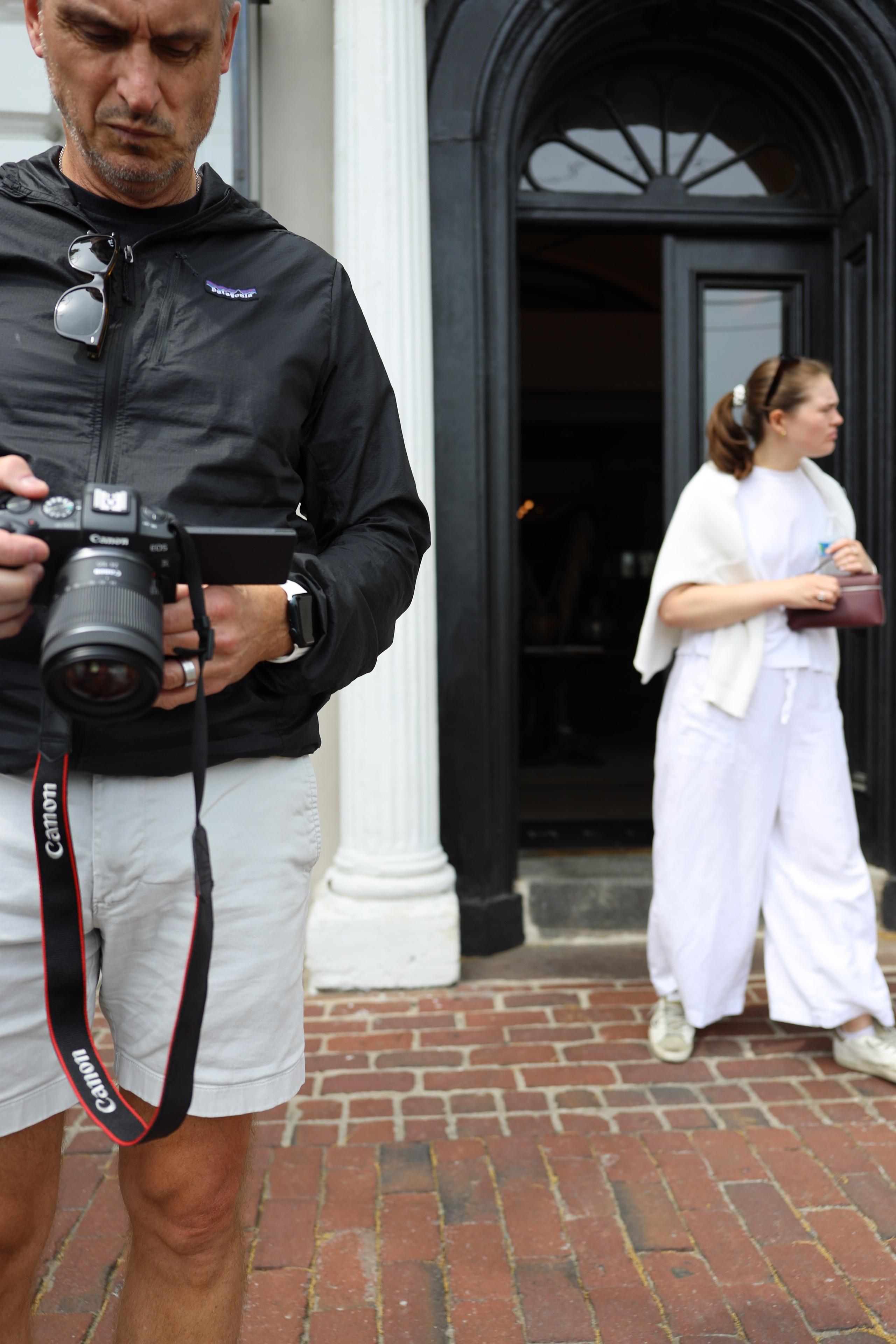
Sonny’s teaching experience comes through very clearly. A discussion rather than a presentation, suitable for every level, and this group covered every level. The best thing to say is that we all left with much better understanding of what DoF is, and how to achieve this in one’s photos, and what draws the viewer into the scene. What is the subject, most important aspect, and how to draw the viewer to the subject. Well done. Left with a much better understanding of the subject, and how to put it into practice. 5/5